.png)


Alex Channing & Rosie Smith
6 Jun 2024
An Intimate Look Into the Private Life of a Guitar Legend
Jimi Hendrix is one of the great enduring figures in music history, and he’s undoubtedly one of the best and most recognisable guitarists of the rock and roll era.
Following his move to London in late-1966, his life and pursuits became extremely well-documented - with countless stories of his time in Soho, his presence on Carnaby Street, and seemingly endless concerts and performances throughout the city. Among all of this, there is still one site that stands out - 23 Brook Street, where Jimi lived for almost a year towards the end of the sixties, and is now a museum that is open to the public. The Handel Hendrix House (named for Jimi himself, and the German composer George Frideric Handel, who lived in the townhouse next door) is certainly one of the most fascinating and tangible places you can go to get a real glimpse into Jimi’s life - from his status as a guitar hero to his more private, personal moments.


The Handel Hendrix House does not function like a run-of-the-mill museum, where patrons enter, observe, and leave. Its curators try to make the experience as interactive and intimate as possible, in order to give guests something out of the ordinary - something more special. Jimi’s flat has been meticulously reconstructed to look just as it would have during the time he lived there, and guests are encouraged to look around - to examine his record collection, for example, and to peer out of the window he would have peered out of everyday himself. Sitting on the mantelpiece - the pièce de résistance, perhaps - is a mirror that actually belonged to Jimi during the time he lived here. Looking into it, you can picture him doing the same, perhaps while fixing his hair, or trying on one of his signature psychedelic-inspired shirts. This piece, in particular, allows you to feel incredibly connected to him, despite all of the legend that surrounds him; you’re able to picture Jimi, the person, instead of Jimi Hendrix, the icon.
A highlight of the bedroom itself is the inclusion of countless trinkets - all of which have stories behind them. Interestingly, in the corner, near the bed, there are two landline phones. Olwen, one of the curators at the museum, explained that Jimi did actually have two landlines, and this was because he tended to give his phone number out to anybody who asked for it, and so the main phone was near-constantly ringing. As a result, he bought a second phone, with the intention of keeping one strictly for music-related queries, and the other for friends and family. Though, in typical Jimi Hendrix fashion, he tended to forget which phone was used for which purpose. Things inevitably got mixed up, and, eventually, he ended up with two phones perpetually ringing. In the end, both were unceremoniously unplugged.


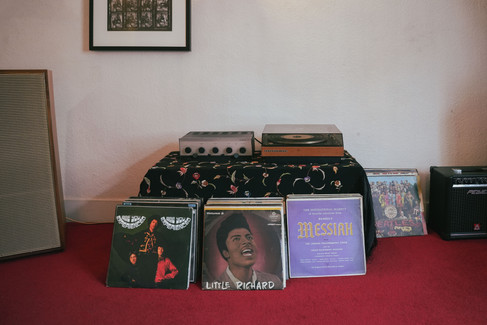
The museum also boasts a beautiful, antique sofa that once belonged to Jimi. Kathy Etchingham, who was Jimi’s girlfriend when he lived at 23 Brook Street, recently donated it to the museum, and the heavy ornate piece was shipped back to England all the way from Australia. Apparently, it was originally kept in the small room just down the hallway from Jimi’s bedroom, and was, more often than not, completely covered in clothes. When it was not, however, friends and musicians crashed on it for the night in typical rockstar fashion.
One of the most recent additions to the museum, and one that fans of glam-rock will particularly enjoy, are three large posters of Jimi that were once owned by the legendary Freddie Mercury of Queen. The curators shared that when the Handel Hendrix House acquired these posters, there was still blu-tack on the corners from where Freddie had hastily stuck them up. Some corners of the posters are even torn slightly, and it’s easy to envision Freddie putting them up, and pulling them down, and putting them back up again. Standing in that small exhibition room, you can just imagine one soon-to-be rockstar peering up at one of his musical heroes in awe, oblivious to the fact that, decades later, fans of both artists would also be admiring them. A must-see for sure.
Some other exciting attractions are a section of the original staircase in the house - the one that Jimi would have walked up and down countless times - and the first guitar Jimi played on British soil - a 1960s Wandre, which he found with Chas Chandler of The Animals while on the hunt for a left-handed guitar.


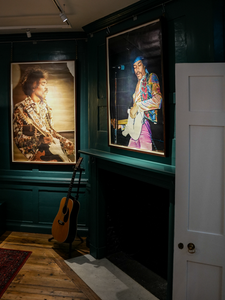
The Handel Hendrix House is an unmissable experience for Hendrix fans - and, indeed, fans of music in general. Even if you’re primarily going for Jimi’s flat, don’t forget to check out the Handel side of things, which is just as fascinating. 25 Brook Street has numerous artefacts that once belonged to the eighteenth-century composer, including several of his instruments. A lot of Handel’s work was likely composed in the townhouse, including his most famous piece - Messiah. It’s awe-inspiring to walk around, knowing such defining works were created within the walls. Also, there are a number of fascinating links between Handel and Hendrix, despite the fact that they’re separated by a little over two-hundred years - musically, culturally, and even in their interior design tastes. And, naturally, there’s also an eerily compelling story about Jimi supposedly seeing Handel’s ghost when he was in the bathroom in the middle of the night.
If you’re visiting the Handel Hendrix House, don’t forget there are many places of interest for a Hendrix fan, all within walking distance - pubs he frequented, for example, such as The Ship on Wardour Street. It’s also close to the last site of the Marquee Club, where he often performed (which is now a Spoons), as well as to Ronnie Scott’s - the jazz club where Jimi gave his final performance, just a few days before his passing.
The Handel Hendrix House is not to be missed - whether you’re a fan of Hendrix, or a fan of Handel, you’ll undoubtedly come out as a fan of both.
Words by Alex Channing & Rosie Smith // Photos by Sarah Pruim